In a move that will enable its employees to earn more money from stock options — and perhaps motivate them to settle for fewer of them in pay packages as a result — Google said yesterday that it would create a system allowing options to be sold as well as exercised.
Under the program, Google will grant employees a new type of option, called a transferable stock option. The company will work with Morgan Stanley to set up a market that will enable financial institutions and other investors to bid for those options.
Experts briefed on the plan were divided on whether it might provide a useful model for other companies. But the move appears likely to reinforce Google’s reputation for financial innovation. When it went public in 2004, Google priced the initial offering through an auction, allowing any investor to get in on the offering, rather than granting assured allocations to preferred investors.
That led to an offering price of $85, which was below what some had expected. Those who bought have prospered, as the share price has risen to a high above $500. Yesterday it closed at $481.78, down $2.15, before the options plan was announced.
Google said the plan was aimed at showing employees the full value of their stock options. In addition to giving options to most new employees, Google also issues options annually to many employees who have been with the company for more than a year.
Stock options give their owner the right to buy stock for as long as 10 years at a price set when the options are granted. Google officials said they believed that employees typically underestimated their value.
“It is very difficult for employees to understand what their options are worth,” said Dave Rolefson, Google’s equity and executive compensation manager, in an interview. “If they can see what others would pay for them, then option valuation would become simple for employees.”
The new options, which will have lives of 10 years, will have the same vesting schedule as existing options, with some options vesting after 12 months and all vesting within four years. Once the options are vested, employees will be able to hold them, exercise them or sell them. They are likely to reap greater gains from selling than from exercising them.
For example, an employee who holds a vested option permitting him to buy shares at a strike price of $460, assuming the stock is trading at $482, can currently exercise the option and pocket $22. The new transferable stock option could be worth a lot more than that, because of the expectation that the stock could rise further.
Google said any options that are sold when their remaining life is greater than two years would immediately become two-year options. In those two years, the financial institution or investor buying them would not be able to sell the options in a secondary market, but would be able to use various financial instruments to hedge against fluctuations in Google’s stock price.
The financial institution is likely to pay less than it would if the option life was not reduced, but much more than the employee would receive if he or she exercised the option and sold the stock.
In trading yesterday, an option to buy Google for $460 a share in January 2009, a little more than two years from now, sold for $123.50 in trading at the Philadelphia Stock Exchange, far more than the value that would have come from exercising it now. A financial institution that bought such an option now from an employee probably would pay a price below that level, but not too far below it.
Even options with strike prices higher than the value of the company’s stock — so-called underwater options — would probably have some value in the market being created, and they could be sold by Google employees. Yesterday, at the Chicago Board Options Exchange, a January 2009 option with a strike price of $520 sold for $99.80. For years, technology companies opposed efforts of accounting rule makers to force them to record as an expense the cost of options granted to employees. Since the rule went into effect last year, some have tried to change the terms of the options, or the assumptions made in valuing them, to reduce the reported expense. But Google’s change, because it will increase the expected life of the options, will raise the reported cost of each option.
In the long run, however, Google’s reported profits could climb if it is able to offer fewer options to attract and retain employees.
“We want to continue to use stock options, but we don’t want to be wasteful either,” Mr. Rolefson said. “We won’t need to use as many options to deliver the same value to employees.”
Wednesday, December 13, 2006
Google to Offer Variation on Stock Options

Tuesday, December 12, 2006
Take Your Blog to the Next Level

With WordPress blogging software and a compatible host, you can customize your blog pages and gain greater control.
If you're a new blogger, Google's free Blogger service will meet your needs. But if you're a born-to-blog pundit like me, you want additional features, personalization, and control.
Blog-o-MaticTop-flight bloggers are increasingly moving to WordPress, Automattic Productions' no-cost, open-source blogging software. Unlike the basic blogging tools found in Blogger, Microsoft's Windows Live Spaces, and Yahoo 360, WordPress offers tons of plug-ins and widgets for customizing your blog. One of my favorite WordPress features is its spam filter, which weeds out spam posted as comments. You can also make your blog private, allowing only the people you specify to read and comment on your postings.
But WordPress gives you more than a simple chronological Weblog: The program's pages feature makes it a full-blown content-management system supporting complex Web sites. For example, WordPress templates let you keep your bio, contact info, or other static content easy for your blog visitors to access.
WordPress's PHP script files require the MySQL database and PHP software running on the host server. After editing one of the scripts to include your MySQL and PHP user names and passwords, you upload the scripts to the server--and just like that, you have a blog.
If this seems like programming voodoo to you, relax. WordPress and most of its hosting partners provide point-and-click tools that have you blogging in minutes.
If you're happy using a subdomain (such as scottspanbauer.wordpress.com) rather than your own domain (www.scottspanbauer.com, for example) and don't mind an occasional text ad among your postings, you can create a free account on Automattic's WordPress.com, a blog-hosting service much like Google's BlogSpot. At the time of writing, free WordPress.com blogs were limited to 25MB of images, PDFs, and other files. The amount of text that you and your readers can post is unlimited, however. (Automattic plans to add commercial account options that increase storage.)
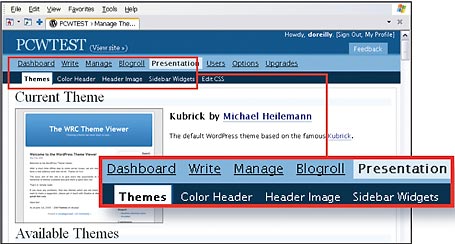
If you choose WordPress.com as your host, setup is a breeze. When you log in, a toolbar of configuration options appears at the top for creating posts and pages, changing themes, moderating comments, and adding links to a page's sidebar (see FIGURE 1: Customize your WordPress blog by using the point-and-click options that are available on the service's toolbar.). You can receive e-mail support from WordPress's creators, too.
For collaboration, create additional author and moderator accounts and set the blog to be invisible until it's ready.
Try the Hosts With the Most
To use WordPress to publish a blog or site on your current Web host, your hosting service must support PHP and MySQL. Independent services such as Blue Host and Laughing Squid offer WordPress support and charge as little as $7 a month; go to wordpress.org/hosting to see a list of such services. A personal note: I adore my local mom-and-pop ISP for its high levels of customer service, technical savvy, and stability, but when I broached the subject of supporting WordPress blogging, the company wasn't prepared. If I were to create a WordPress blog using my own domain name, I would probably select one of WordPress's recommended host services.
Blogging for Dollars: Cash In With Google's Adsense
If your blogging consists of posting pictures of the kids for Great-Aunt Millie to see, or detailed accounts of your bunion surgery, don't expect to strike it rich as a pro blogger. But if what you say is interesting to even a modest audience, you could receive a check each month by placing ads on your blog. One of the easiest ways to test the Web-ad waters is with Google's AdSense service, which context-matches Google text ads to your blog's content and optionally places a Google search box on your site.
By Scott Spanbauer, PC World
Subscribe to:
Posts (Atom)